What a master teaches cannot be written down. It can only be received, and then, before it is lost, it must be recorded.
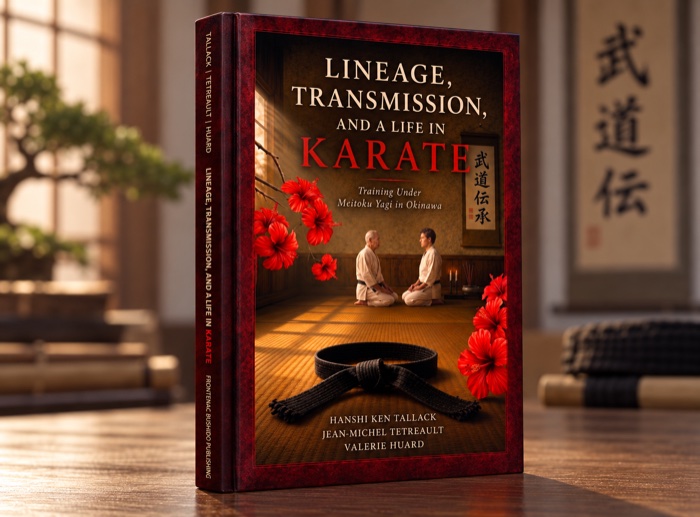
Hanshi Ken Tallack trained under Meitoku Yagi Dai Sensei in Okinawa across eight years. Yagi Dai Sensei was himself a direct student of Goju-Ryu founder Chojun Miyagi. This book is Ken's record of what he received, including his first-hand account of the creation of a kata still practiced today.
 Get it on Amazon.ca
 Get it on Amazon.com
Karate is disappearing. Not from popularity. From depth.
Grandmaster Meitoku Yagi is gone. So is Matayoshi Shinpo. So is Nagamine Shoshin. The men who trained hand to hand with the founders of modern karate, who stood on the same floor as the people who invented these arts, are almost entirely gone now. What they carried did not come from a book or a seminar. It came from decades of proximity, absorbed one correction at a time.
When that generation dies, the direct line dies with them unless someone wrote it down while it was still open.
Ken Tallack is one of a shrinking number of Western practitioners who trained directly with that generation. From 1985 to 1993 he returned to Okinawa again and again for training that spanned eight years, including a stretch of just under three years living near Grandmaster Yagi's dojo, walking over most mornings to train or simply to listen. This book is that record, taken from him in his own words and checked against every document that survives.
Five generations. One line that has never broken.
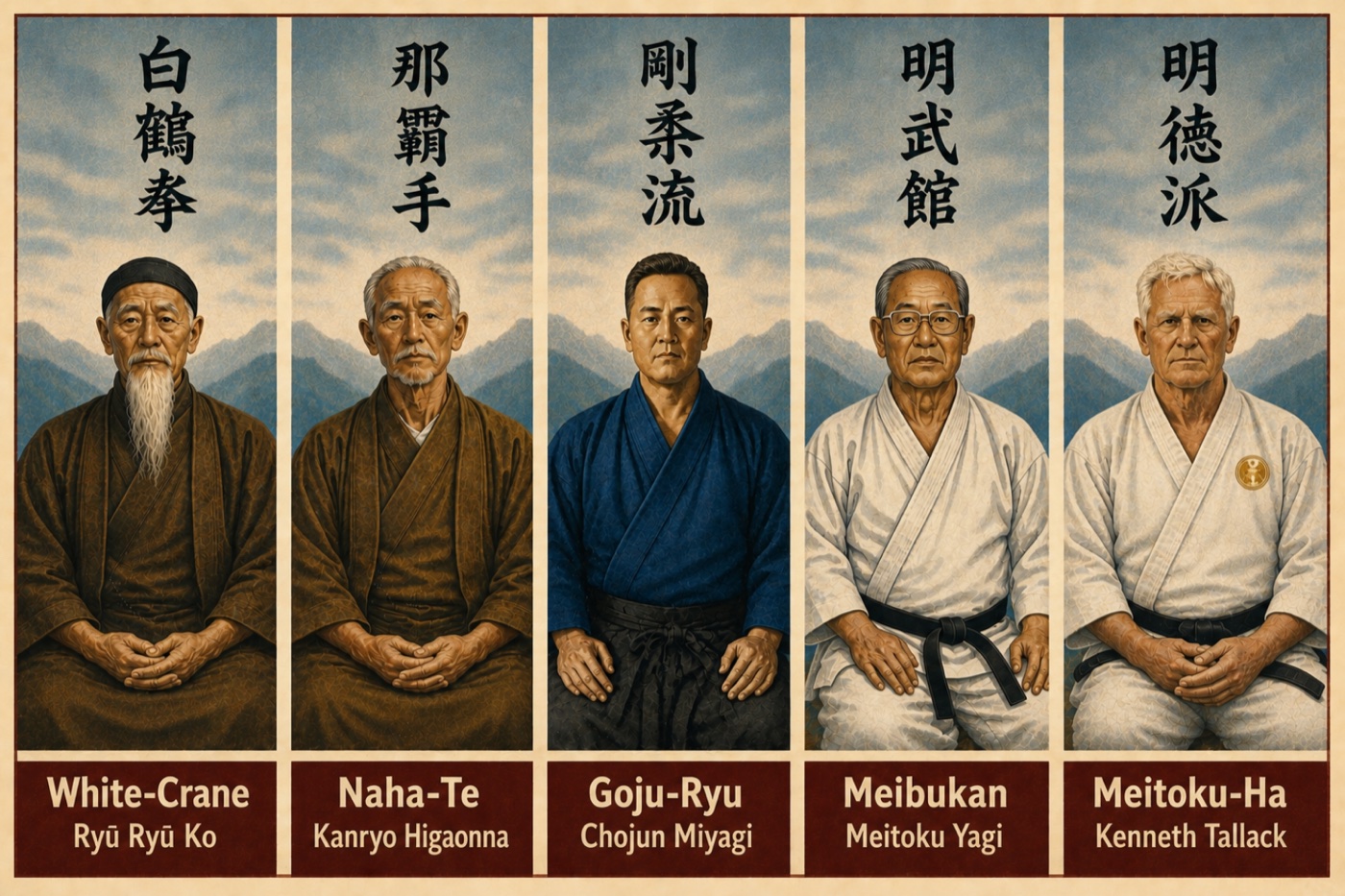
Everything in this book passed through five hands. Ryuryu Ko taught Higaonna Kanryo in Fujian. Higaonna Kanryo taught Chojun Miyagi in Okinawa, who founded Goju-Ryu. Miyagi taught Meitoku Yagi Dai Sensei from the age of fourteen, and he carried the art alone after Miyagi's death in 1953. In 1985, Yagi Dai Sensei accepted a Canadian student named Ken Tallack, the first Canadian he ever trained personally.
That chain is the reason this book exists. A story told secondhand is folklore. A story taken directly from the last man standing in the line, checked against dates and rosters and the record of who stood where in 1952, is history.
Five things this book preserves
He watched a kata get invented.
Kata are not usually created in front of witnesses. They are built over generations, tested and adjusted until only what works survives, and by the time a student learns one, its origin is usually many decades and many teachers in the past.
Ken Tallack watched one get made. In Okinawa, in the company of Yagi Meitoku Dai Sensei and Nagamine Shoshin, he was present for the creation of Byakko, White Tiger, a kata still taught today. What he took from that room was not a new technique to add to a list. It was a shift in how he understood every kata he already knew, the difference between performing a form and being asked something by it.
This book is where he records it, in his own words.
Written by the man who lived it, with the two people who made sure it was recorded right.

Born in 1955 in St. Thomas, Ontario, and started in a YMCA judo class before he was ten. By 1985 he had spent nearly two decades building a career in the martial arts when he traveled to Okinawa and became the first Canadian student personally accepted by Yagi Meitoku Dai Sensei. Yagi Dai Sensei conferred his 5th Dan directly in 1987. Tallack lived in Okinawa from 1991 to 1993, training with Yagi Dai Sensei almost daily. He holds the Canadian Karate Kungfu Association 10th Degree and Master of Five Animal Shaolin, is Dai Nippon Butoku Kai Hanshi of Karate and Kobudo, and holds the 8th Dan in Okinawa Karate & Kobudo. He was inducted into the Canadian Black Belt Hall of Fame in 2017 and estimates he has taught more than 100,000 students across almost sixty years.

Spent more than a year documenting, structuring and fact-checking Tallack's account with Valerie Huard, cross-referencing his memory against surviving rosters, timelines and records wherever a paper trail existed. Tétreault is a retired Major in the Canadian Armed Forces and an engineer with four decades in Shotokan karate. With Valerie Huard, he co-authored the Put That Stuff Down series, with more than 60,000 copies sold.

Co-author of the bestselling Put That Stuff Down series, with more than 60,000 copies sold. She brought that same editorial discipline to preserving Tallack's voice on the page, working alongside Tétreault for more than a year to document and fact-check the account.
Who should read this
Goju-Ryu and karate practitioners who want to understand where their own training came from. Martial arts historians and students of Okinawan culture. Anyone whose own teacher trained under this lineage, directly or at a distance. Readers who collect martial arts biography and oral history.
It is not a technique manual and will not teach you a kata. It is not an official history of the Meibukan, and it does not speak for the Yagi family, who remain the living authority over that tradition. It is one student's faithful account of what he personally witnessed and received, offered with respect for the people who still carry that line in Okinawa today.
Get the book
"As a scholar, I appreciated the authors' attention to documenting their claims, and their honesty about the limits of their historical record."
"This book is a must read for all serious budoka, no matter your Art or Style."
"A must have in every martial artist's library."
"Engaging, clear... a very different approach to writing about martial arts related topics, a good balance of subjective and objective."
Canadian Karate Kungfu Association 10th Degree and Master of Five Animal Shaolin. Dai Nippon Butoku Kai, Hanshi of Karate and Kobudo, 8th Dan Okinawa Karate & Kobudo. First Canadian student personally accepted by Meitoku Yagi Dai Sensei.
Readers are sharing their copies
Questions
The window is closing. The record is not.
The men who trained beside the founders of modern karate are almost gone. Ken Tallack is one of the last Western practitioners who trained directly with that generation, and this book is his account of what he received from them, in his own words, checked against the record.